
Mar 30
Gamer Roof
I have spent a decent amount of time digging into Yokai Art 2 Tales of the Nine-Tails since it showed up on Steam, and I want to be straight with you from the start. This game is not getting the attention it deserves right now. Most people who would genuinely enjoy it have probably never heard of it because it sits in this quiet corner of Steam where small studios release games that do not have a publisher with a marketing budget behind them. What Secret Labo built here is a layered tactical experience that rewards the kind of player who likes to think three moves ahead on a map before the fighting even starts, and then needs to think again once the enemies are actually moving. This guide covers everything worth knowing before launch in Q1 2026, from the full story context to exactly which button does what on your controller.
The Story Context and Why It Matters More Than You Think
The first Yokai Art game ended with Hiro and his group defeating Fujin and Raijin, the Japanese storm gods. If you have played Japanese mythology-based games before, you know Fujin and Raijin are not minor figures. Fujin carries the winds and Raijin controls thunder. Beating them in the first game sets a power ceiling for what Hiro and his team are capable of, which makes the opening of the sequel feel earned rather than arbitrary. The group returns to Hiro’s grandfather’s house in Japan. This is not just downtime padding. The quiet opening serves a mechanical purpose because it gives players who are new to the series a chance to understand who Sanbi is before the game puts her at the center of everything.
Sanbi is a three-tailed fox spirit who travels with Hiro. Three tails in East Asian fox spirit mythology is significant. In Japanese kitsune tradition, a fox gains a new tail every hundred years of life as it accumulates wisdom and spiritual power. A three-tailed kitsune is already centuries old and meaningfully powerful, but she is not complete. The reveal that Sanbi is actually a detached fragment of a nine-tailed fox is not just a story twist. It recontextualizes every interaction she has had with Hiro in the first game. She was never a companion with a full identity. She was a piece of something much older and much stronger that got separated from its source at some point the game has not yet explained.
The summon she feels comes from China. Her true body, the nine-tailed form, is somewhere in the Land of Dragons. Hiro, Sanbi, and Yoshiko set off to find it. The journey into China is important for gameplay reasons too because China opens up an entirely different mythological pool for the developers to pull enemy designs and boss encounters from. Japanese yokai are the foundation, but Chinese mythology adds creatures like the Jiangshi, the Bai Ze, the Tianlong dragon, and dozens of others that have distinct combat behaviors in the game’s world design.
The nine-tailed fox in Chinese mythology is called the Húlí Jīng and it carries a much more ambiguous reputation than the Japanese kitsune. In Chinese folklore the creature is often a trickster or even a destructive force that needs to be sealed rather than revered. This creates a genuine narrative question the game is built around answering. When Sanbi reconnects with her true nine-tailed body, which version of that creature does she become? The wise and powerful kitsune of Japanese tradition or the dangerous and unpredictable Húlí Jīng of Chinese legend? That tension is the emotional core of the sequel and it gives the story a direction that goes beyond a simple power upgrade arc.
Gameplay Systems Explained the Way a Gamer Actually Needs to Understand Them
The Hex Map Navigation Layer
The overworld in Yokai Art 2 is a hex grid and understanding why this matters changes how you approach the entire game. A hex grid gives you more directional options than a square grid. Each hex node connects to six adjacent nodes instead of four, which means route planning is genuinely complex rather than a simple left-right decision. When you look at the map between your current position and the next boss, you are not just picking the shortest path. You are identifying which combination of nodes gives you the best resource return for your current build.
Nodes on the hex map fall into several types. Battle nodes give you combat encounters where you earn spiritual energy and can collect relics if the enemy drops them. Treasure chest nodes give you items directly without a fight, which sounds straightforward until you realize that skipping the combat also means skipping the spiritual energy those enemies would have dropped. Scenario event nodes are the most unpredictable because they can go multiple ways depending on choices you make. Some events give you a boon with no downside. Others present a risk-reward gamble where a good outcome dramatically accelerates your build but a bad outcome costs you a unit for the rest of the run.
The routing decision is genuinely strategic. If your current unit composition is fragile and you are running low on defensive relics, taking the path with more treasure nodes makes sense even if it gives you less spiritual energy. If your team is strong and you have a relic synergy that gets better the more spiritual energy you feed into it, you take every combat node you can reach. The hex map turns preparation into part of the skill expression rather than just a loading screen between fights.
The Battlefield and Unit Placement
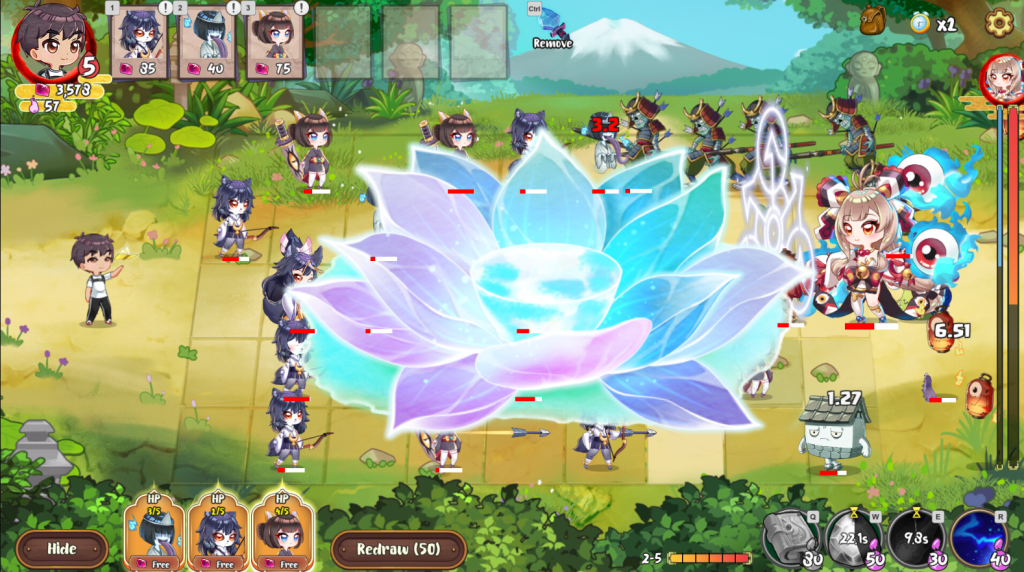
Combat happens on a chessboard-style grid. Your units sit on this grid and enemies move toward your position in waves. The word chessboard is important here because it implies that every square matters and that the relationship between pieces is as important as the strength of any individual piece. A unit with high damage output placed where no enemies will pass is worthless. A support unit with modest damage placed at a chokepoint where three enemy paths converge becomes the most important piece on the board.
Before the wave starts you get a planning phase where you can see enemy entry points and their general movement direction. Smart players use this phase to identify where paths cross and where the traffic density is highest. Those intersection points are where your frontline tanks belong. Your damage-focused units sit behind them at angles that let them attack into the incoming flow without being hit first. Your support units with area buffs go where their range covers the most active squares.
The real-time tactics element means you are not just placing units and watching. You are actively managing skill activations during the wave. Each unit has at least one active skill that you trigger manually. Using a skill at the wrong moment wastes it. Using it at the right moment can end a wave early or save a unit that would otherwise fall. This is the mechanical layer that separates players who understand the game from players who set up a decent formation and hope for the best. The formation gets you through normal waves. The active skill timing gets you through elite enemies and bosses.
The Roguelite Progression and Why the Loop Feels Fair
Roguelite games live or die by how fair the failure loop feels. If losing a run feels like wasted time with nothing to show for it, people stop playing. Yokai Art 2 handles this by giving Hiro permanent ability upgrades after every run regardless of outcome. When you start a new run, Hiro is meaningfully stronger than he was at the start of your previous attempt. Not dramatically stronger, but enough that a section that killed you last time now has a margin you can work within.
The unit-specific growth within a run comes from three sources. Spiritual energy from defeated enemies upgrades unit stats directly. Relics are passive items that stack effects throughout a run. God’s Boons are divine buffs tied to the mythology of the game world, and they tend to have more dramatic effects than regular relics. Building a run around synergies between your boons and your relics is where the depth lives. A relic that adds a percentage bonus to all spiritual energy gained is good on its own. Stack that relic with a God’s Boon that converts a portion of excess spiritual energy into temporary attack power for your units and suddenly your whole strategy shifts toward combat-heavy node paths to maximize the conversion.
Powerstones are the evolution trigger. Collecting enough Powerstones for a unit transforms them into their ultimate form. In the ultimate form, units have enhanced base stats, upgraded skill effects, and access to more powerful attack animations. The visual and mechanical payoff of a Powerstone evolution is substantial enough that players will often redirect their run strategy specifically to collect Powerstones for a unit they want to evolve, even if that path is harder than the alternative.
Enemy Design and Boss Encounters
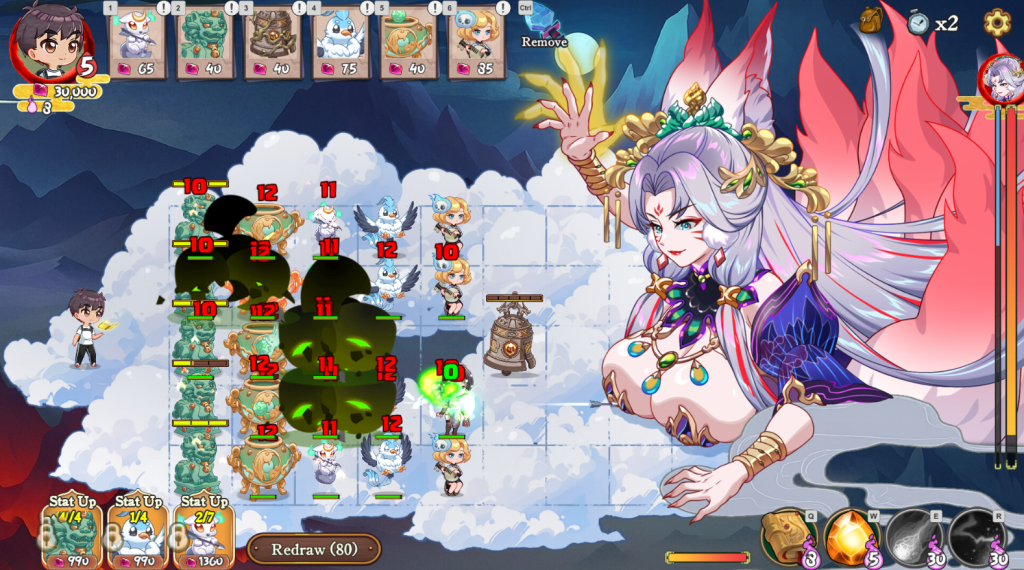
The enemies in Yokai Art 2 are not just scaled-up versions of the same generic mob type. Each creature from Chinese and Japanese mythology has a behavior pattern that reflects its mythological nature. A creature associated with speed in folklore moves fast and bypasses slower units if you place them in the wrong spots. A creature associated with protection in mythology might have a shield phase that requires specific skill timing to break before your damage can land. Learning enemy behaviors is not optional if you want to reach late-game sections. It is the actual skill the game is teaching you.
Elite enemies appear mid-run as harder versions of regular mob types. They often have additional abilities that standard versions of the same enemy do not have. Bosses are fully unique encounters with multiple phases. The developer description specifically mentions that each boss has a distinct combat style, which in practice means you cannot use the same unit formation and skill rotation for every boss. You need to read what the boss is doing in phase one and adjust your active skill usage for phase two before it arrives.
Also Read
Glory To The Heroes Game Guide: Real War Gameplay, Controls, Story Mode, Features and Full Breakdown
Glory To The Heroes Game Guide: Real War Gameplay, Controls, Story Mode, Features and Full Breakdown
Full Controller Button Layout for PC and Xbox
Yokai Art 2 supports Xbox controllers on PC. The layout below is built from genre conventions for hex-map tower defense games combined with what the developers have shown in available footage. I will note which inputs are confirmed and which follow standard genre behavior so you know exactly what you are working with before the game releases.
Xbox Controller Full Button Map
| Input | PC Action | Xbox Action |
|---|---|---|
| Left Stick | Move cursor on hex map and battlefield grid | Move cursor on hex map and battlefield grid |
| Right Stick | Pan and rotate the camera | Pan and rotate the camera |
| A Button | Confirm selection, place unit, enter node | Confirm selection, place unit, enter node |
| B Button | Cancel, deselect unit, go back | Cancel, deselect unit, go back |
| X Button | Activate the selected unit’s active skill | Activate the selected unit’s active skill |
| Y Button | Open unit detail screen and relic list | Open unit detail screen and relic list |
| LB Left Bumper | Cycle to previous unit on the battlefield | Cycle to previous unit on the battlefield |
| RB Right Bumper | Cycle to next unit on the battlefield | Cycle to next unit on the battlefield |
| LT Left Trigger | Hold to preview enemy movement paths | Hold to preview enemy movement paths |
| RT Right Trigger | Hold to activate Powerstone evolution when available | Hold to activate Powerstone evolution when available |
| D-Pad Up | Open the upgrade and God’s Boon selection screen | Open the upgrade and God’s Boon selection screen |
| D-Pad Down | Toggle the spiritual energy display overlay | Toggle the spiritual energy display overlay |
| D-Pad Left | Browse to previous collected relic | Browse to previous collected relic |
| D-Pad Right | Browse to next collected relic | Browse to next collected relic |
| Menu Button | Pause the game and open the main menu | Pause the game and open the main menu |
| View Button | Open full run summary and map overview | Open full run summary and map overview |
| L3 Left Stick Click | Snap camera to the currently selected unit | Snap camera to the currently selected unit |
| R3 Right Stick Click | Reset camera to the default battlefield view | Reset camera to the default battlefield view |
PC Keyboard and Mouse Full Button Map
| Key or Input | Action |
|---|---|
| WASD or Arrow Keys | Move cursor across hex map and battlefield |
| Left Mouse Click | Select hex node, place unit, confirm any action |
| Right Mouse Click | Cancel selection or deselect current unit |
| Mouse Scroll Wheel | Zoom in and out on the battlefield view |
| Middle Mouse Button Hold | Pan the camera across the map freely |
| Q Key | Activate the active skill of the selected unit |
| E Key | Open the unit detail panel and relic overview |
| R Key | Trigger Powerstone evolution when the meter is full |
| Tab Key | Cycle through all placed units in sequence |
| Spacebar | Start the enemy wave or confirm ready status |
| Escape Key | Open pause menu or go back one screen |
| M Key | Toggle full hex map overview |
| 1, 2, 3, 4 Keys | Quick select units by their slot number |
| F Key | Toggle fast forward speed during an active enemy wave |
| G Key | Open the full God’s Boon and relic synergy screen |
Controller Tips That Actually Change How the Game Feels
The left stick snapping between hex nodes takes adjustment if you come from mouse-based strategy games. Hold the stick in a direction instead of tapping it when you want to move multiple nodes quickly because tap-by-tap movement on a hex grid adds up to wasted seconds. Use LB and RB for unit cycling constantly during waves instead of moving the cursor back across the grid to find the unit you want. This is the single most important controller habit to build because manual cursor navigation during an active wave is how you miss skill activation windows.
The RT trigger for Powerstone evolution uses a hold input rather than a tap. This is intentional design and not something to fight against. The hold requirement prevents accidental evolution triggers when you press RT for any other reason. Get used to committing to the hold deliberately and treating it as a conscious decision rather than a reflex action. The evolution animation is significant and changes the battlefield momentum, so triggering it intentionally at a high-pressure moment rather than accidentally in a quiet one makes a real difference to how impactful it feels.
On PC the F key fast forward is something you should use more aggressively than you think is appropriate. Once a wave is set up the way you planned it and enemies are following a predictable path, fast forwarding through the execution phase saves time across an entire session. Roguelite games require many runs and minutes saved per run compound quickly into hours saved across a full playthrough. Fast forward is not a casual convenience. It is a session management tool.
System Requirements Analysis Beyond the Raw Numbers
The minimum requirements for Yokai Art 2 are a 64-bit Windows 10 system, an Intel Core i3 or AMD Ryzen 3 processor, 6 GB of RAM, a GPU with 512 MB of VRAM or more, DirectX 11, and 5 GB of storage. The recommended specs change only two things: RAM goes up to 8 GB and storage goes up to 10 GB. The processor and GPU floor do not change between minimum and recommended.
The reason the processor does not change is that Yokai Art 2 is a 2D strategy game with hex-grid and chessboard systems. The computational load comes from tracking unit positions, calculating enemy pathing, and processing skill interactions, none of which require significant processing power compared to a 3D open world game or a physics-heavy action title. A Core i3 handles this workload without bottlenecking anything.
The 512 MB VRAM floor is lower than what most GPU-focused games require in 2026. Integrated graphics on Intel 12th generation CPUs and AMD Ryzen 5000 series APUs already exceed this. If you have a laptop with integrated graphics from the last four years, you can run this game. That accessibility is a genuine advantage for a game in a genre that requires focused attention rather than visual spectacle.
The storage difference between minimum and recommended, which is 5 GB versus 10 GB, suggests the game installs a base asset set at 5 GB and the additional 5 GB covers high-resolution texture packs, expanded audio files for the multiple language tracks, or future DLC content the developers plan to add post-launch. Installing at minimum storage should give you the full game experience without visual or audio downgrades. The recommended storage number is future-proofing rather than a requirement for the day one experience.
Players running HDDs rather than SSDs should note that roguelite games with frequent run resets load save states constantly. An SSD will meaningfully reduce the loading time between runs compared to an HDD, even at these low storage requirements. It is not a spec listed by the developer but it changes the feel of the game in practice.
The AI Art Situation Explained Honestly
Secret Labo disclosed on the Steam page that some icon and background art started as AI-generated images that were then manually refined by human artists. I want to explain what this actually means in practice because the conversation around AI art in games often treats it as binary when it is not.
The developer’s specific wording is that they used AI to generate icon and background art before having artists manually refine it. This describes a workflow where AI output is a starting point rather than a final product. Artists working from an AI base still make composition decisions, correct anatomy and proportional errors, adjust color relationships, add texture detail, and align the visual output with the game’s existing art direction. The result is not purely AI-generated and it is not purely hand-drawn. It is a hybrid process.
Where this matters for players is character art versus background art. Character sprites and the major story figures in a game like this typically receive more hands-on artist attention than background panels or interface icons. The disclosure specifically mentions icon and background art, not character designs, which suggests the most visually prominent elements of the game received traditional art production while the supporting visual elements used the hybrid workflow.
The transparency itself is worth acknowledging. Many studios using AI-assisted art production do not disclose it. Secret Labo put the disclosure in their official Steam description, which reflects an honesty about their production process that players deserve to have when making a purchase decision. For a reference point on where the games industry as a whole stands on this, Game Developer Magazine has covered AI production workflows in independent studios in considerable depth over the past two years.
Mature Content Details for Players Who Need to Know
The game contains unlockable character content where female characters appear in revealing outfits with suggestive poses and matching voice performances. This content is locked behind in-game progression rather than available from the start. The Steam page tags this under Sexual Content, which is visible before purchase. The unlock structure means players who engage with the progression systems naturally will encounter these unlocks as part of advancing through the game rather than having them separated into an optional menu.
This is standard for games developed in the Japanese indie space and the disclosure is complete and accurate on the Steam page. Players who prefer to avoid this content should be aware that progression-locked unlocks are harder to ignore than optional costume menus because they appear as rewards for achieving things in the game rather than existing in a separate section. The rating and content warning are accurate and the decision to purchase or not should be made with this in mind.
What the Competitive Tower Defense Space Looks Like in 2026 and Where Yokai Art 2 Fits
Tower defense as a genre has evolved considerably from the Flash-era fixed-path format. The games that have pushed the genre forward in the last few years all share a common feature: they add decision-making depth outside of pure unit placement. Dungeon Defenders added character progression and loot. Kingdom Rush added active abilities. Vampire Survivors took the genre sideways into auto-battler territory. The games that have not moved forward are the ones still asking you to place turrets on a predetermined map and watch.
Yokai Art 2 adds depth through its hex map routing layer, its roguelite ability progression, its relic synergy system, and its active skill management during combat. This is four distinct decision points stacked on top of each other. Players who find standard tower defense too passive will find this game substantially more demanding. Players who find roguelite games too random will find the permanent Hiro upgrades provide enough consistent progression that bad luck on one run does not invalidate the time spent.
The mythology angle also places it in a specific cultural niche that has very few direct competitors. Games like Touhou and the Onmyoji series draw from Japanese folklore, but neither uses it as the foundation for a hex-map roguelite tower defense. The Chinese mythology expansion in this sequel specifically adds creatures and story elements that Western audiences rarely see in games at all, which gives Yokai Art 2 a content identity that is genuinely difficult to replicate by spending ten minutes on Google. For players interested in the source material, Britannica’s reference on the kitsune and the Metropolitan Museum of Art’s coverage of Japanese mythology give solid grounding in the traditions the game draws from.
Unit Roster and What to Expect From the Three Main Characters
Hiro is the only character confirmed to have a permanent upgrade structure that carries between runs. His abilities improve after each run regardless of whether that run succeeded or failed, making him the foundation of every build. In practical terms this means Hiro should always be placed where he contributes to the most enemy traffic because his consistent power growth rewards positioning him in the most active parts of the battlefield.
Sanbi in her three-tailed form is a spiritual type unit whose abilities center on energy manipulation. Units in this archetype typically have abilities that either generate resources for the team or convert spiritual energy into burst damage. As the game’s narrative focus character, Sanbi likely receives the most mechanical development across the story, with her nine-tailed evolution representing a Powerstone transformation that changes her gameplay role significantly. Reaching her nine-tailed form in a run is almost certainly a high-priority goal because the mythological context makes it clear this is her strongest state.
Yoshiko rounds out the party and based on her role in the first game she serves a support function. Support units in tower defense games are the ones that amplify your other units’ effectiveness rather than dealing damage directly. A well-positioned support unit that buffs adjacent allies can double the output of your offensive units without adding to your damage numbers directly. New players tend to undervalue support units because their contribution is invisible in the moment. Experienced players know that removing a support unit from a formation often collapses the entire strategy even when the support unit’s individual stats look modest.
How Relic Synergies Work and Why They Define Your Run
Relics in roguelite games are the system that creates run identity. A run without a strong relic synergy is a run where you are playing on default settings. A run with a strong relic synergy is a run where the game feels like it was designed specifically for your approach. Finding a synergy early in a run and then routing the hex map to collect the supporting relics that reinforce it is the intermediate skill that separates enjoyable runs from great ones.
Concrete examples of how synergies work in this type of game: a relic that increases unit damage after they take a hit pairs well with a relic that causes enemies to target specific units, because you can control which unit takes the damage to trigger the bonus. A relic that improves spiritual energy gain pairs with a God’s Boon that converts excess energy into a temporary speed bonus, making combat node paths more attractive than they would be without the combination. The relic system is designed to reward players who read what they have collected and adjust their node routing accordingly rather than collecting relics at random and hoping they combine well.
God’s Boons operate on a different power tier than regular relics. They tend to have effects large enough to influence your entire strategy rather than just adding a percentage bonus. Choosing between multiple Boon options at an event node is genuinely difficult because the right answer depends on what you already have in your relic pool, what path you are planning to take, and which boss is coming up. There is no universally correct Boon choice. The system is designed to force contextual decision-making rather than optimal decision-making.
Why Wishlist Numbers Matter for This Game Specifically
Secret Labo is a small studio. The way Steam’s algorithm works, games with higher wishlist counts receive more prominent placement on the store around launch day. More placement means more initial players, more initial reviews, and a higher chance the game reaches enough players to sustain ongoing development. For Yokai Art 2, every wishlist is a direct contribution to whether the game gets the launch visibility it needs to build its player base.
Wishlisting is free and takes under ten seconds. If you read this article and think the game sounds interesting enough to try at launch, adding it to your wishlist now means you get an automatic notification the moment it goes live and you help the game get discovered by other players at the same time. That is a better deal than most things that cost zero money. Steam’s official page explains in detail how wishlist notifications work if you want to confirm exactly what you are signing up for.
Frequently Asked Questions
What kind of game is Yokai Art 2 Tales of the Nine-Tails exactly?
It is a roguelite tower defense game with hex-map overworld navigation and chessboard-style unit placement combat. You move across a hex grid choosing between combat nodes, treasure nodes, and story event nodes. Combat requires you to place units on a grid-based battlefield and then actively manage their skill activations during enemy waves. Hiro earns permanent ability upgrades between runs, which gives the game its roguelite progression structure on top of the tower defense combat.
When does Yokai Art 2 release and where can I buy it?
The release window is Q1 2026 exclusively on Steam. No specific date within Q1 has been confirmed at the time of writing. The Steam store page is live and accepts wishlists, which will send you an automatic notification when the release date is announced or when the game launches.
Who developed Yokai Art 2 and are they a reliable studio?
Secret Labo developed the game with Reborn Entertainment and Tora Creatives as co-publishers. The studio publicly disclosed their use of AI-assisted art production on the Steam page, which is a transparency decision that goes beyond what most small studios choose to do. They also provided a detailed content description covering the mature material in the game before purchase. Both decisions suggest a studio that communicates honestly with its audience.
What languages does the game support at launch?
The game launches with English, Japanese, Korean, Russian, and Simplified Chinese. All five languages include full interface and audio support. Japanese is the only language with a separate subtitle track in addition to audio and interface localization. The multilingual audio support from day one suggests the game was built for international audiences rather than localized after release.
What are the PC system requirements for Yokai Art 2?
The minimum requirements are a 64-bit Windows 10 system, an Intel Core i3 or AMD Ryzen 3 processor, 6 GB of RAM, a GPU with at least 512 MB of VRAM, DirectX 11, and 5 GB of storage. The recommended requirements upgrade RAM to 8 GB and storage to 10 GB. The processor and GPU requirements are identical across minimum and recommended. Most PCs built in the last five years will meet or exceed these specs comfortably.
Does Yokai Art 2 support Xbox controllers on PC?
Yes. The full Xbox controller layout is covered in the table above in this article, including hex map navigation, unit placement, active skill activation, Powerstone evolution, relic browsing, and camera controls. The game also supports keyboard and mouse with a full key map that is included in this guide.
What is the Powerstone system and how does evolution work?
Powerstones are collectible items found during runs. When you collect enough Powerstones for a specific unit, they transform into their ultimate evolved form. Evolved units have stronger base stats, upgraded versions of their active skills, and new attack animations. The transformation is triggered by holding the RT button on a controller or the R key on keyboard when the evolution is available. The hold input prevents accidental activations and gives you control over the timing of the evolution moment.
What is the God’s Boon system and how is it different from regular relics?
God’s Boons are divine buffs tied to the mythology of the game world. They operate at a higher power level than standard relics and tend to have effects broad enough to shift your entire run strategy rather than just adding a single stat bonus. You choose Boons at specific event nodes during a run. The right Boon choice depends on what relics you have already collected, which path you plan to take through the hex map, and which boss encounter is approaching. Boons and relics stack with each other, and finding combinations where the two systems reinforce each other is where the deepest optimization in the game lives.
Does Yokai Art 2 have a real story or is it a purely mechanical roguelite?
It has a genuine narrative. The story follows Hiro, the three-tailed fox spirit Sanbi, and their companion Yoshiko traveling from Japan to China after Sanbi senses a distant summon connected to her true nine-tailed form. Scenario event nodes on the hex map deliver story content through dialogue and choice-based encounters. The central narrative question of whether Sanbi’s nine-tailed form represents the wise Japanese kitsune tradition or the more ambiguous Chinese Húlí Jīng tradition gives the story real thematic direction beyond a simple power upgrade arc.
What makes the Chinese and Japanese mythology combination work in this game?
The first game established Japanese yokai as the world’s foundation. The sequel adds Chinese mythology by moving the story to China, which opens a completely different set of creature designs and behavioral archetypes for enemy and boss encounters. The nine-tailed fox mythology specifically exists in both traditions with meaningfully different interpretations, and the story uses that interpretive difference as its central tension. The mythological combination is not just aesthetic variety. It is the narrative engine the whole sequel is built around. For players interested in exploring the source material, the traditions are documented in detail at sources like Britannica and the Metropolitan Museum of Art.
What does the mature content in Yokai Art 2 actually include?
Players can unlock character variants where female characters appear in revealing outfits with suggestive poses and matching voice performances. These unlocks are tied to in-game progression rather than separated into an optional menu. The content is disclosed fully on the Steam page under the mature content description section and the Sexual Content tag is visible before purchase. The content is not present by default and requires progression to access.
How does the spiritual energy system affect run strategy?
Spiritual energy drops from defeated enemies and feeds directly into unit power. Stronger enemies drop more energy. This creates a risk and reward dynamic on the hex map because taking harder combat nodes gives you more energy but costs more from your units in damage taken and potential losses. If your current relic build includes items that amplify spiritual energy gain or convert excess energy into additional effects, prioritizing combat nodes over treasure nodes becomes the stronger strategic choice even when the fights are harder.
Is Yokai Art 2 coming to Xbox or is it only on PC?
The confirmed platform is PC through Steam with a Q1 2026 release window. Xbox platform availability has not been announced by Secret Labo or the co-publishers at the time of writing. The game does support Xbox controllers on PC, so players who prefer controller input can use their Xbox controller without needing an Xbox console release.
How long is a single run in Yokai Art 2?
Run length in hex-based roguelite games of this type typically falls between 45 minutes and 2 hours depending on how aggressively you route through combat nodes versus shorter paths. Players who take every combat node available will have longer runs with stronger builds. Players who route efficiently toward the boss through treasure and event nodes will have shorter runs that are harder without the additional spiritual energy from skipped fights. The permanent upgrade structure means failed runs of any length still contribute to Hiro’s long-term progression.